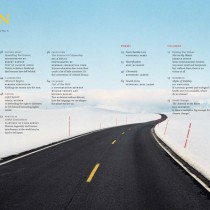
Outside Magazine Exposure April 2012
March 30th, 2012
A shot I made while snorkeling on a wreck in Southern Greece was just published in the April 2012 issue of Outside Magazine.
Last weekend was the opening of a massive photo festival in Knokke-Heist, Belgium called Wonderland. Christophe De Jaeger, the curator of the Museum of Fine Arts in Brussels (BOZAR), chose six international photographers to show their work all over town, indoors and outdoors on a gigantic scale. The photographers include Michael Light, Ruud Van Empel, Sanna Kannisto, Olaf Otto Becker, Corey Arnold, and Gerco De Ruijter. Knokke is a high class beach town on the coast of Belgium and they spared no expense producing enormous inkjet prints on Canvas and Dibond plates. The show was designed to be a bike tour taking you on a scavenger hunt around the city and countryside. I also had a solo exhibition of Fish-Work images at the Sincfala Museum in Heist. Here are some snaps! Oh, and I was interviewed by A Belgian TV station called Cobra. You can watch the video here.
I was commissioned by Audubon magazine last year to document the Corvina and shrimp fishermen of El Golfo de Santa Clara, Sonora, Mexico. We went in search of the people that fish amongst the elusive Vaquita, better known as the next cetacean heading for extinction since the loss of the China’s Yangze River Dolphin in 2007. In short, very few of the fishermen we met and spoke with had ever seen a Vaquita in their lives, yet environmental leaders helped the government pass buyback programs which permanently confiscated fishing permits and presented other incentives to reduce fishing, including swapping out nets for money in order to protect the inevitable extinction of the Vaquita. Published in the Nov/Dec 2011 issue of Audubon Magazine, this is the story of the fishermen of El Golfo de Santa Clara vs. the ghost dolphin with the eternal smile. Please enjoy the attached outtakes from our journey.
Heather Treadway is a multi-talented fashion designer, musician, dancer, etc. from Portland, Oregon. In the fashion realm, she specializes in designing and sewing unique handmade capes. I spent a weekend in Eastern Oregon near the Painted Hills and Blue Basin road tripping and photographing Heather wearing some of her recent designs. You may also know her as the stand up percussionist from the band Explode into Colors (rest in peace). Buy her stuff on Etsy or email her to make a custom order. She’ll make you something great.
I’m just home from a two week road trip to San Diego and back. My good friend Greg Hennes of Antler an Co. shot this little iphone shot of me planking an old oak trip in Big Sur. I love that place.
For those that don’t know me well, I’m not just a photographer, I’m a commercial fisherman. Every summer I spend a couple months running a commercial Sockeye salmon set net operation at the mouth of the Kvichak River in Bristol Bay, Alaska. For the past four seasons, I’ve been photographing this surreal lifestyle at our seasonal squatter camp in an abandoned cannery called Graveyard Point. I first discovered Graveyard while shooting for this Outside Magazine piece back in 2008 and immediately fell in love with the place. Images from the new series are scheduled to launch along with a whole new website redesign very soon!
Meanwhile, a huge mine is setting up shop upstream from Graveyard!!! It’s time to kick some giant foreign corporate ass:
The Pebble Partnership is a coalition of huge foreign mining corporations who have staked out mineral rights in the headwaters of two of the largest wild sockeye salmon spawning rivers left in the world. If allowed to proceed, these corporations will dig one of the largest open pit mines in the world. A lake would be needed to contain the up to 10,000,000,000 tons of toxic mining waste which would then be contained by an earthen dam larger in mass then the Three Gorges Dam in China (in an extemely seismic location). In my mind, it is not possible for a mine of this scale to co-exist with the approx. 38,000,000 sockeye salmon returning each year to Bristol Bay to spawn. Given the poor track record hard rock mining has had in regards to clean water, and the sheer scale of what these guys are trying to do, I cannot imagine this story ending in anything less then an unfixable environmental catastrophe and at best, and economic disaster for the fishermen and natives that are sustained by Bristol Bay salmon.
We’ve already devastated most of the great salmon runs in California and the Pacific Northwest due to dams and pollution. Let’s make sure that Pebble Mine doesn’t happen to Bristol Bay.
I’ve teamed up with Trout Unlimited, the Renewable Resources Foundation, and others to fight the massive propaganda campaign paid for by Northern Dynasty Minerals (Canada) and Anglo American (UK). We desperately need the EPA to step in and assess the situation as so far, the mining corporations have been responsible to hire their own “environmental impact studies” with virtually no public oversight. Check out the Save Bristol Bay website to find out more about what you can do to get the word out and decide for yourself.
On the back cover of the December 2011 issue of Alaska magazine is a portrait I shot this summer of my fellow fishermen at Graveyard Point. Thanks to the Renewable Resources Foundation who is doing good work to protect help save the future of the people that co-exist with the Bristol Bay ecosystem. Also thanks to all my fellow Graveyarders for coming out in force to sit for this photo! I can’t wait to get back out there in June.
I’m flying off to Sydney today and will open a group show at the Paper Mill Gallery, in Sydney on Thursday night, May 12 from 6-9pm. Hope to see you there! The show is part of the Semi-Permanent schedule of events for the weekend. I’ll be showing three new pieces from my Fish-Work Europe series.
Also, swing by Semi-Permanent on Friday at 1pm when I’m scheduled to bore 2000 onlookers with my slideshow of naked animals, recent travels in illegal countries, and childhood photos of me with fish blood on my diapers.
I’m honored to have been invited to speak at the Semi-Permanent Creative Conference in Sydney, Australia on May 13-14, 2011. There will be an associated group exhibition (TBA) and I’ll be signing and selling copies of my new book: Fish-Work: The Bering Sea. 2000 eye pairs will supposedly be present (gulp). I’m really excited to get back to wombatland. Don’t be (a) stranger(s).
I assumed that my recent interview in Ireland’s largest newspaper, the Irish Times was going to be a simple story about why I was in Ireland for the Irish Skipper Expo doing a slideshow presentation about my life as a commercial fisherman and photographer in Alaska, and my recent tour of 8 European countries photographing commercial fishermen around the EU. Instead, the editors that shaped the article falsely quoted me in a headline that thrusts my misquoted opinion into sydication around the blogosphere. The headline reads” EU fisheries policy an attempt to ‘wipe out’ coastal fishing communities. This post is my rebuttal to a poorly titled interview that involves me in a larger debate in which my (falsely quoted) opinion should not be the centerpiece of the article as I’m clearly not an expert on European fishing politics.
1. The headline is a dramatic exaggeration. I’m smiling and holding a crab in the picture. Why should the headline be about fish politics? I’m here in Ireland to show my photography, not preach my opinion on fisheries politics. I would have never said that the EU common fisheries policy is trying to “wipe out” coastal fishing communities. I would just never say something like that. Coastal communities are surely not benefitting from the current policy but I do not believe that anyone is trying to “wipe out” communities. It’s more complicated then that. Unfortunately, no one that I’ve met in Europe is happy with the current EU fishing policy. In the interview, I had only given examples of how I thought it would be beneficial to the coastal communities if there were, for example: less quota restrictions on small inshore mackerel jiggers as the amount of fish caught by small inshore jiggers is minuscule compared to that of the discarded fish of the larger vessels. From my limited experience travelling in Ireland, the Mackerel jigging community in Donegal I joined seemed to me like an example of a clean and healthy small scale fishery.
2. “Fishing Dude” Who’s quotes are that? When has anyone ever called me a “fishing dude”?
3. I never said that I found some of “the most dramatic examples” of the threat to small boat fishing in Scotland and Ireland. I said that I experienced the highest level of worry about their future, from fishing communities in Ireland and Scotland. Coastal communities are suffering all around Europe, but people here seem to be even more concerned then the rest.
4. I never said that EU fisheries policy makes it “almost impossible” for small boats. I do think that the policy is not benefiting small boats, but I’m just not that dramatic about how I express myself. Small boat fishermen are generally less united then the larger fishing companies, and therefore probably have less influence on shaping policy for their benefit, as is the case the world over. I do not know the details of EU fishing policy, I only know what I’ve learned from talking to fishermen around Europe and my photography is not politically motivated, therefore this is not an argument for me.
5. The quote ” They barely get enough quota to survive, compared to the much larger vessels which get most of the quotas and can discard up to 50 percent of their catch”. Everyone agrees that fish dumping due to the selective quota system is one of the biggest problems facing the fishing industry. If there were measures to taken to control dumping, and allow fishermen to actually sell their bycatch, then its possible that the fishermen could make more money, land more fish, yet kill less fish overall. More quota could then be allocated to the inshore to medium sized boats and everybody wins. This is my simplified opinion of a much more complicated argument and I feel that the article should have expressed more of my hopeful optimism then this doomsday language that it meant to attract readers to dramatic headlines.
6. I mentioned the success of the observer program in Alaska and the lack of details might be confusing. 100 percent of Alaska’s larger trawlers have scientific observers on board to collect data on the fish being captured. Obviously fishermen do not want cops aboard their boats watching their every move, but in Alaska, these observers have a fairly harmonious relationship with the fishermen they live with on a daily basis. Observers are primarily on board to gather data that would benefit the future of the fish stocks. It might also help prevent the dumping of undersized fish… a practice which is driven by market forces. Everyone does it in order to compete and deliver larger, quality fish. So, I think an observer program, at least on the largest trawlers such as in Alaska, could be an idea explore.
In conclusion, I’m a photographer with a love of commercial fishing, fish, and the culture of people who make their living from the sea. My pictures are motivated by a desire to share this love of fishing with the world, and to hopefully inspire, educate, and provide a historical record of this period in fishing history worldwide. I’m an advocate for sustainable fishing practices, but by no means consider myself an expert on the matter nor and expert on the fishing policy of foreign nations.
I’ll be adding new images to the new FISH-WORK Europe portfolio on my website throughout this week leading up to my exhibition at Charles A. Hartman Fine Art in Portland, OR on Thursday. The pictures were taken in Ireland, Scotland, Poland, Germany, Netherlands, France, Spain, and Greece this year and part of a broad project, documentating the state of the commercial fishing industry in Europe and sponsored by the PEW Charitable Trust.
Norway is my favorite country on Earth, but life near a warm sea with fresh octopus hanging on racks has its perks as well. I had an enormously good time traveling around Greece this September on assignment for En Route Magazine. I can’t say enough about how great this magazine is to work for. 5 star hotels and my own private yacht for a few days! It was not the type of boat travel or weather that I’m used to, but I’ll take it. Below are some out takes. I’ve been getting into the posed group portrait lately and will soon apply for my dream job as an Olan Mills photographer.
Last week I joined my friend, Gilles, searching for seafood along the shores of Douarnenez, in Brittany, France


This could very well be my most traveled year ever. After three weeks in Ireland and Scotland, and a few days in Baton Rouge shooting an ad for Capitol One, I was commissioned by Alaska Seafood to photograph fishing families in Juneau, Kodiak, Dutch Harbor, and Naknek. Amazing assignment, and even more amazing people met along the way. From Naknek, I fired up my skiff and set out with good friend/writer/deckhand Tim Sohn for five weeks commercial fishing for sockeye salmon at the mouth of the Kvichak River. Fishing was out of control good. Little sleep was had. Many fish lives were lost.
Back in March/April of this year, I tagged along for some Pollock dragging on the 149 ft. Pacific Prince out of Dutch Harbor, Alaska. The assignment from OnEarth Magazine (NRDC) was to document the fleets efforts to avoid excessive salmon bycatch and capture the overall feeling of life as a trawlerman in the Bering Sea. Here are some of the spreads as well as a few I like that couldn’t fit into the story. I love assignments that apply 100% to my life’s work.
I’m just back from a trip in the Bering Sea aboard a Pollock trawler and getting over the random bout of pneumonia upon return. Stay tuned for more pictures after the story goes to print.

On rare occasions, a surfable wave appears at the spit in Dutch Harbor, Alaska. These pics were taken on Jan 18, 2010 actually during twilight hours. But you’ve got to wear a seagull destruction helmet to survive the “beakings“. The wave breaks at the base of the Icicle Seafoods fish guts and bits discharge pipe so watch out for 10,000 hungry birds, 300 pound halibut and boat sized sleeper sharks nipping at your toes.


photos: Corey Arnold
This place is underrated for sure.
I’m off to Dutch Harbor, Alaska for a few weeks. Gonna be in a similar place as in the picture.
This time it’s a personal mission. If you need to reach me urgently, please email Maren Levinson or one of the galleries listed on the contacts page. Skitt Fiske!


I spent June and July this summer commercial fishing for salmon in Bristol Bay and following up with pictures on last years Outside magazine story about the proposed Pebble mine. It’s been very busy over here with magazine assignments, my salmon business and upcoming group exhibitions so I’ve only just begun to sort through the summers huge arsenal of new pictures! As soon as I’m home for a solid week or two, I’ll be adding a ton of new images to the site. Hopefully, I’m not crying wolf again this time.